Monday, February 23, 2015

The Woes of Student Multimedia Presentations

Why do my students love the  


so much?


I'll tell ya why, it's the same reason they love to have a million different types of font in their multimedia presentations.  

They want to drive me insane.

Oh, and it's not just the kids who love the Fancy Font. Full grown adults like to snaz up their .ppts with them too, maybe even with several different variations for our viewing pleasure.
It's an absolute crime that Powerpoint allows for words to drop from the PowerPoint heavens, one letter at time, in Edwardian Script ITC. A crime against teacher sanity. 

Ridiculous.  How is it in 2015, training professionals are still creating animated PowerPoint presentations with mind numbing animations? I'm going to reach a bit and claim that we, as a sophisticated group of teachers, are no longer impressed with the Fancy Font or the animated clip art from the Microsoft Gallery.  It's painful to watch and stop making us do it!

Therefore, we have the NO FANCY FONT rule in my classroom. As a result, I am attempting to establish a set of guidelines to help my students create multimedia products that are effective AND aesthetically appealing.  Not just fancy.

I created this infographic at piktochart.com (for free) to hopefully help give my class some guidelines for classroom multimedia presentations that aren't cluttered with ridiculous fonts, clip art or animations.
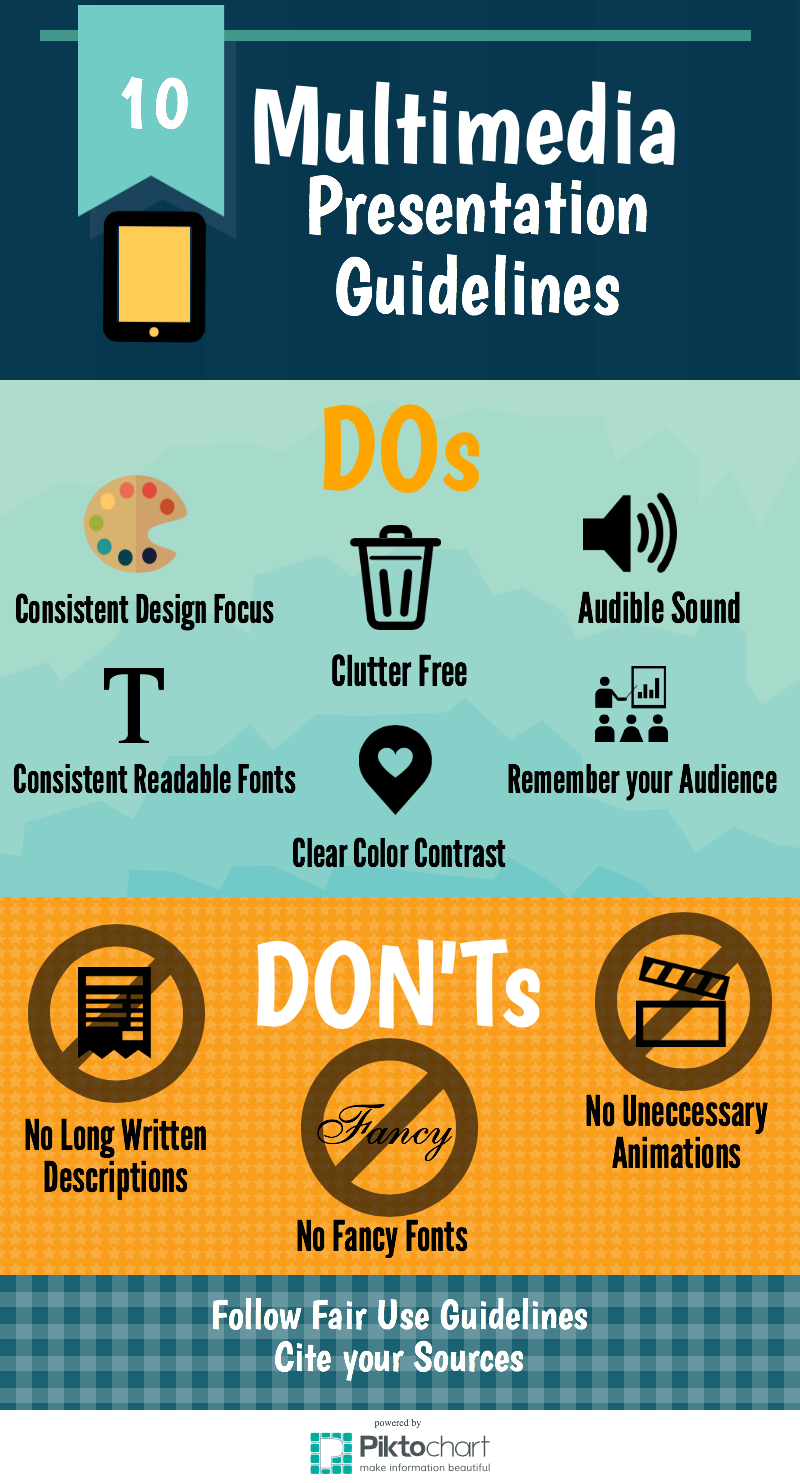


I tirelessly combed the internet for a definitive source on providing students with guidelines for multimedia presentations. But in the end, I had to do it myself. Like most things.


I just had to "Git 'er done," as we sophisticates like to say.


IMS Bove


Saturday, February 21, 2015

Memorizing the Gettysburg Address

Again, my students have inspired me. 
My heart swells. 
My 6th grade students memorized the Gettysburg Address, 
and so did I.

Well, I did, but I messed up on about 8 words (out of 271). Also, I needed a kick start at two points during my recitation, which my students carefully recorded when I allowed them to assess my recitation. 

But enough about me, all 13 of my 6th grade students recited the Gettysburg Address from memory after studying it for 3 weeks, all with 95%-98% accuracy. I have a 5th/6th combination class, my 5th graders memorized the Preamble. In fact our entire 5th grade team of 90 students memorized the Preamble with 99%-100% accuracy (see my blog here about the Preamble).  But even more amazing our 6th grade team of 76 students attempted the feat of memorizing the Gettysburg Address.  Most of them accomplishing the task with only a handful of students who fell short of the goal.

When we first set forth on this task, I felt trepidatious.  I was asking my students to attempt a feat I myself had not attained. Therefore, I made a promise that I would memorize and recite the address as well.

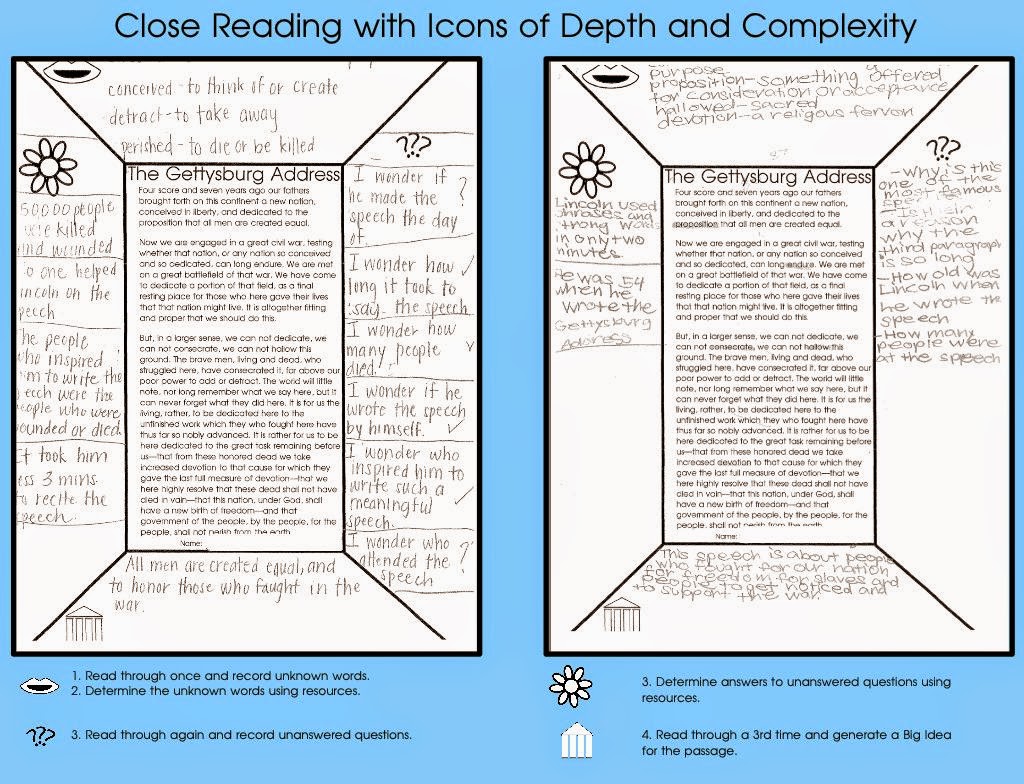
Before starting, in collaborative groups, students completed a self guided close reading using the Icons of Depth and Complexity. Directions on how to complete this lesson is available on my blog, and the templates are available for free at my TPT store: IMS Bove.
FREE!

I gave my students time to work on memorizing their passages during Daily 5 each day and provided self assessment close worksheets for morning work. 
This bundle is available at my TPT store.

Another GREAT resource is the Gettysburg Address available for free download, a song we listened to several times, by the Bonus Point Band. Here is their free audio download of the song. Also here is the free download of their video.

Their Youtube video is available here:


I am so proud of my students, and I am inspired.

IMS Bove


Saturday, January 31, 2015

Close Reading with Icons of Depth and Complexity: Simplified

(I am updating this strategy with a new post here, but wanted to leave these directions for those of you who are just starting out and want to use this strategy in it's simplest form). Here are the amped up directions for those interested in using this strategy with a little more meat.

Close Reading is all the rage these days. 

It's getting a lot of paparazzi attention in teaching circles.  
Or am I just late to the party?

Anyways, I am currently working on helping my 5th Graders memorize the Preamble (to the United States Constitution) and my 6th graders memorize "The Gettysburg Address."

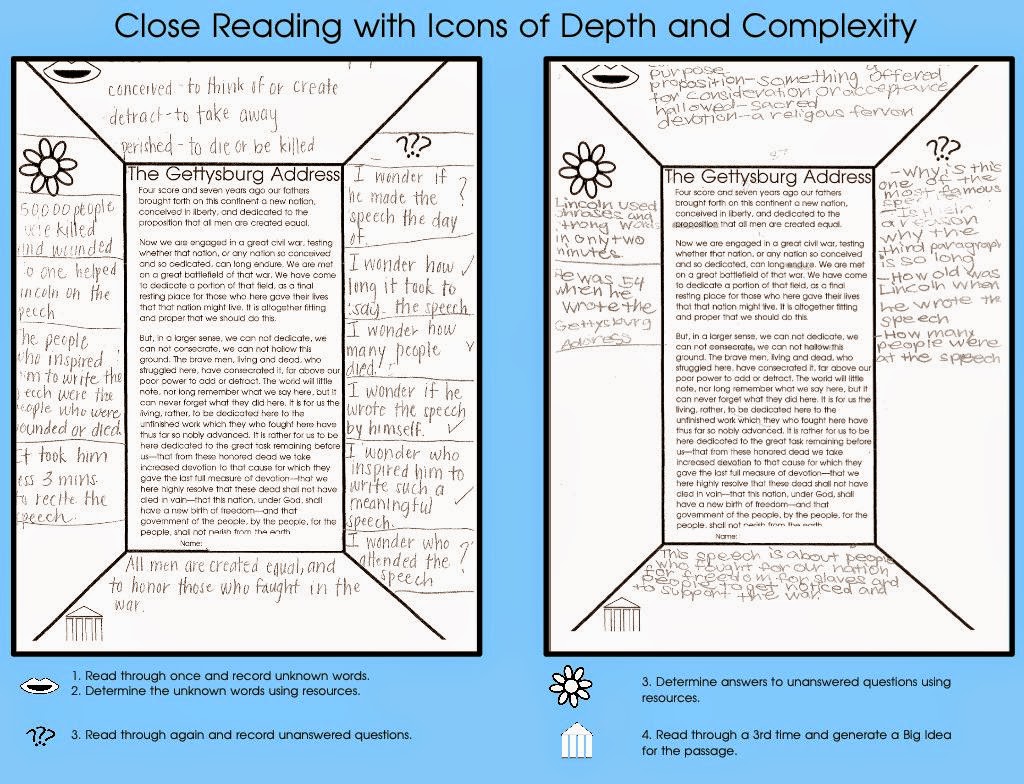
We started with close reading strategies using a frame organizer incorporating the Icons of Depth and Complexity. If you aren't familiar with the Icons, it isn't necessary to "know" them to use this lesson. 

Download the frames here for Free from my IMS Bove TPT Store. 
Click on the picture below.


1. To begin with, I had previously exposed both speeches to my class by watching informational videos on Brainpop.com and listening to the songs mentioned in my blog on this page.
2. Then I passed out the frame and asked students to highlight any unfamiliar words in the passage.


3. Afterwards, I asked them to record up to 4 of the highlighted words in the Language of the Discipline Section.
4. Then they looked up the meaning of the words. We used iPads, but be careful of the word "propositioned" in the Gettysburg Address.  

5. We then shared out our new vocabulary and discussed words that may have had multiple meanings.


6. Next the students read the passage again, this time recording any Unanswered Questions they may have encountered while reading. 


7. Afterwards, they researched the Details for the answers of least 4 questions.


8. Finally, we read the article again looking for he Big Idea of the passage. After a discussion, students recorded their ideas.


STUDENT SAMPLES


I have to say, I felt like both of these Close Reads were successful in helping the students understand the meaning of the passages, making them more comprehensible for memorization.

IMS Bove


Friday, January 30, 2015

Memorizing the Preamble to the United States Constitution


The Preamble

Maybe I didn't help this student succeed in grammar, but I did give him the opportunity to memorize the Preamble to the United States Constitution!

Back when I taught 3rd grade a few years ago, a teacher teammate suggested that we have our entire 3rd grade class to memorize the Preamble to the United States Constitution.  I thought she was crazy! 

Our entire 3rd grade class did, which at that time was about 65 pupils. 

Later when I moved back to 5th grade, knowing that my 3rd graders had accomplished this feat, I have them memorize the Preamble as well.  
Prior to jumping into the task of memorizing the Preamble with my 5th graders, I had them complete a self guided close reading using the Icons of Depth and Complexity Frame of the Preamble (available for free at my TPT)

FREE!

Directions on how to implement this lesson are available here on my blog.

Afterwards, what is the best tool for accomplishing this task?  
Listening and singing along to "We the People" from SchoolHouse Rock.


I created some fill in practice sheets and practice cards to help students as well!
My Preamble Bundle can be purchased at my TPT store. Click Below!

IMS Bove

Monday, January 26, 2015

LOOOOONG Division

The only time I ever lied to ANY of my teachers, was in 5th grade. It was over a long division packet.  Sorry Mrs. Larabee, I didn't lose my packet, I am pretty sure I burned it and hid in a deep dark crevasse in the earth. Well, maybe I just tossed it, but if I had that packet now, I would most certainly find pleasure in destroying it right proper!

The guilt I have carried for the past undefined years, has made a lasting impression on how I approach teaching long division with my own 5th graders.  I truly try not to impose my own distaste for completing long division algorithms with my class, but my stomach turns at a page of long division problems.

I will never give my students a packet of long division problems, nor will they ever have to complete a whole page of long division in one sitting.

After completing several directed lessons from our math series on how to complete long division using estimation strategies with the divisor, students were to complete 25 long division algorithms.

I took the opportunity to have students analyze one algorithm with a partner using this worksheet I created using the Icons of Depth and Complexity. This is available for free at my TPT store.

Freebie!


Student Samples


After students completed this in depth analysis with a partner, students were then directed to complete an "Explain Everything" presentation using the iPads (see below for the link). In this presentation, they needed to describe the thought process of completing this problem to a student who may not know how solve the problem.
This is just a sample, and as you can see, there is an error.
But, the error provides opportunities for discussion.


I gave the students a 20 minute time limit, which turned into 30 minutes, but they were very very engaged and using scholarly language while creating their presentations.  These presentations were limited in pizzaz and fine tuning, but due to the time constraint, it is what I expected and requested!  If I had given them all day, these would have been masterpieces complete with light saber pointers and other flair.  

When they finished, I had them complete each other's problems from the assignment, with the promise that we would check our work using the presentations students created. I did not have the students complete all the problems, only about half the problems, and of those, the most difficult.  My rationale is that if students can work through a difficult problem with a partner and understand the process, then they do not need to complete a whole page of mindless algorithms.

I will say this is the most successful I have been at teaching and mastering long division and the students enjoyed it too!  My principal observed this lesson as part of my yearly review and commented on how this lesson was a perfect example of a teacher being a "facilitator."

Success!

IMS Bove


Monday, January 19, 2015

Inductive Reasoning Lessons

Inspired!
 I was just too tired the first 4.5 years of my daughter's life to dabble in my passion for teaching. But just recently, my mind has caught up on those first 6 months of sleep loss, or I have just now gotten into a groove. And out of nowhere, I read a whole book for pleasure, cleaned the grout on my floors and posted some items on TPT all in one week. It's almost too much! So what has inspired me lately? Inductive Reasoning Lessons with my 5th and 6th graders. For the past few years, I have approached teaching Greek and Latin Roots using Inductive Reasoning as an opener to our word list using this fantastic resource:

Learning Works Greek and Latin Roots - Grade Level 4 to 8 Paperback – April, 2004 by Trisha Callella

With Inductive Reasoning, students look for patterns in details and then formulate big ideas based on the information analyzed.  Hilda Taba, researched and advocated for this type of teaching in 60s.
I find that this type of learning is how I personally retain knowledge best, and it is VERY motivating for our students.  
"Oh I love this!" jerks me from my Monday morning daze when I open this lesson on the front board. Did I just hear "I love" a vocabulary lesson from a 5th grade boy? Yep.

How it works:
1. My amazing teacher colleague and I select a word list from the book. Each list is 10 words long and focuses on a Greek or Latin Root.
2. Then we put a notebook file together, which includes picture clues and a pre-filled table with shades. You can purchase it at my TPT store HERE.
3. We pass out this worksheet for the students to record the lesson as we go along.

FREEBIE


4. We also put a copy of the pictures into our shared document account for students to access on the classroom iPads.
5. Then I release the gates.  I allow the students to talk about what they think the pictures represent, telling them that they are all related in some way.
6. I reel them in with some bell ringing and zero signals, and then we attempt to take turns, sharing ideas. The first time this lesson is presented to a group of students, they don't know what to make of it, and are not as vocal. But for subsequent lessons, students are eager to "find" the Big Idea and share ideas.
7. I ask that students do not blurt out the Big Idea until I specifically ask for it to be revealed.
8. A student will say, "Is #1 depressed?" (It's dejected).
9. I reply, "You are on the right track, keeping thinking!"
10. As students guess correctly, the word is revealed with a tap of the screen shade.
11. After a while, I allow students to share their thoughts on the Big Idea of the word list. 
What is the Root Word all these words have/will have in common?
12. Then, students can start to generate ideas about the Rule of the Big Idea.
What do you think the Root Word means?  
With this book, the definitions are written in student friendly terms with like terms in each of the definitions (all definitions will have "throw" in them).
13. Finally, students use the Rule to generate definitions that have a similar Pattern following the Rule. I won't reveal a definition unless the students use "the Rule" in their definition. Generating definitions will happen simultaneously while students are still guessing the vocabulary words.
14. Most of the words and definitions can be generated using this approach, which ends up being both inductive and deductive reasoning. Sometimes, I need to assist with a word/definition once in a while.  

15. Then we practice using the words during our "Daily 5" (actually Daily 3 for our class) using these activities available at my store on TPT. The book also has a few other activities we use during the week, which includes an assessment we also use.

We use the Icons of Depth and Complexity in our classroom, 
but these same ideas can be used without using the icons.

Recently, I applied Inductive Reasoning when introducing 
Geography of Ancient India and Ancient Egypt 
with our 6th Grade Social Studies Curriculum.  
Download it for free at my TPT Store.

FREEBIE


IMS Bove